An accessible unit fits when someone using a wheelchair, a walker, or a cane has to use your restroom — and it also fits when a permit, venue contract, or general contractor's site plan calls for one. The trade-off…
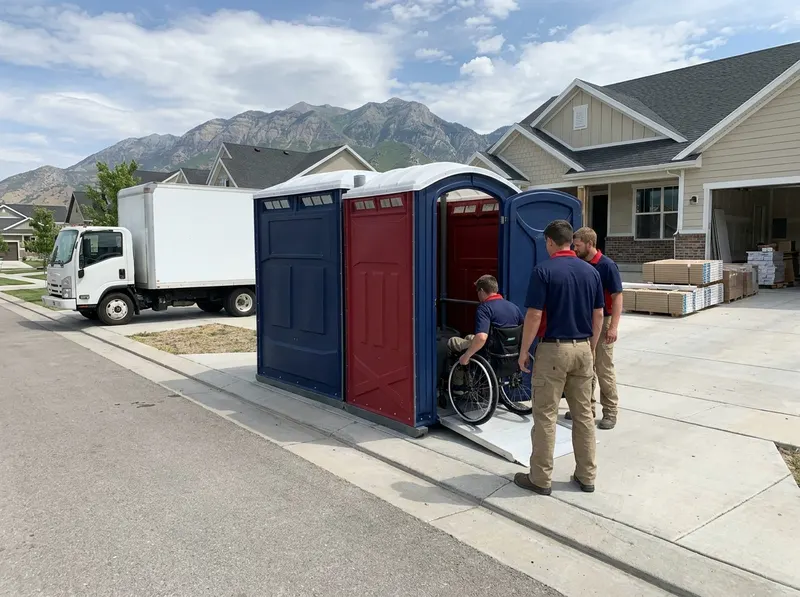
An accessible unit fits when someone using a wheelchair, a walker, or a cane has to use your restroom — and it also fits when a permit, venue contract, or general contractor's site plan calls for one. The trade-off against a standard unit is footprint and access: a standard stall can be tucked into a downtown alley behind the Ballpark neighborhood or squeezed onto a narrow parking strip in The Avenues, while an ADA unit needs a wider clear opening, level ground, and a route with no curb lip or gravel berm to cross. If your only available spot is on a 6% grade off a Capitol Hill or Marmalade District street, we say so up front and look for a flatter pad nearby rather than setting a unit that tips the floor and defeats the point.
Event planners in Salt Lake City hit this most often at Liberty Park, Sugar House Park, the Utah State Fairpark, and trailheads along the Jordan River Parkway Trail, where a grass or crushed-gravel setting means we look for asphalt, a hard shoulder, or a paved apron for the accessible stall while standard units sit on turf. Salt Lake City permitting staff commonly ask for at least one accessible stall in any cluster of portable restrooms at a public event — confirm the exact count with the permit office or venue, and we will build the order around whatever number they give you. On construction work in Rose Park, Glendale, Poplar Grove, Westpointe, and Fairpark, superintendents typically add one accessible unit per site once the trades ramp up; residential remodels in Yalecrest, Liberty Wells, Sugar House, and Federal Heights usually need a single unit set on the driveway rather than the lawn.
Placement is the whole job on an ADA order. We ask about the surface, the slope, the gate width, whether a street closure or University of Utah campus access permit affects the delivery window, and where snow gets plowed in winter — a berm across the door in January makes an accessible unit unusable. Doors are hung to swing away from the traffic side wherever the pad allows. On multi-month rentals we confirm the unit still sits level at each service visit, because subgrade around new curb and gutter work settles.
Service is scheduled, not requested. Weekly pump-out, tank recharge, and paper restock is the default; twice-weekly is the sensible call for festival weekends, film crews, and sites running 20-plus workers through one bank of stalls. Extra pump-outs can be added mid-rental during a heat wave or a high-attendance event day, and they are priced before we dispatch — never bolted on after the fact. One phone number handles the delivery window, the service calendar, and the pickup: (801) 306-0901.
Every job gets a firm, written price after a free on-site visit.
Tell us about your ada-accessible portable toilet rental job in Salt Lake City and we'll send a clear, written quote — usually the same day.
 RoyalForge Porta Potty Group